Thursday, May 1, 2008

Beneath the Southern Cross, Part Four

Shark Bay is the name of a large area. The bay itself is enormous and the land mass surrounding the bay is a peninsula that juts out from mainland Australia and is the most westerly point on the continent. (I like that I can now say that I’ve been to the most easterly point in Australia, the most westerly point and the southern-most land mass in the world besides Antarctica. I don’t know that I’ll make any money off those claims but everyone’s gotta have something.)


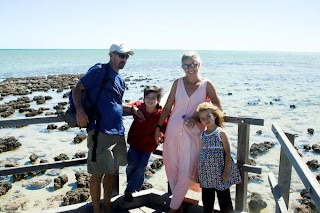
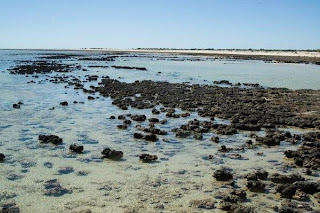
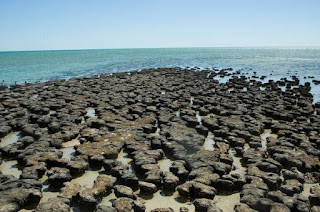
As we began our venture onto this peninsula, we stopped at a few recommended places. The first was the home of the Stromatolites. Now these guys deserve their own blog page, their own website. Tiny, microscopic organisms called cyanobacteria build up to form these stumpy rock-looking creatures called Stromatolites that live in the ocean.


These stumpy rock things are my new heroes. 350 billion years ago, give or take, there was not much oxygen on the earth so it was not a very friendly place for life. The only living things were these cyanobacteria who apparently didn’t need much. But what these organisms did was produce oxygen. Over a few billion years, they increased the amount of oxygen in our atmosphere just enough to make it possible for other, more complex life forms to survive here. Without them, you’d not be reading this blog right now. So while we may feel a deep connection to the chimpanzee as a distant relative, it is these stumpy Stromatolites to whom I feel I owe my life. They only exist in this one area in the entire world because the sea right there is so high in saline that it is too salty for any other animal to live in and therefore, safe for these fragile little Stromatolites because there are no predators or competition for food. Seeing them and learning about their role in, well, in my life, made me feel like I had completed the ultimate pilgrimage. If it weren’t for the flies, I’d have stayed with them to pay homage much longer. But the flies drove us back to the relative sterility of the camper van and on we drove to our next stop.


Shell Beach is a beach where tiny, white, perfect seashells are piled by the trillions, 30 feet deep for several miles. There is no sand to speak of. Just shells. Most of them so tiny you could fit two or three of them on a dime. It is spectacular. But the climate there was just unreasonable. At the parking lot end of the beach were the flies. Once you got on the beach, the fly population thinned (notice I didn’t say disappeared) but the winds picked up and whipped specks of tiny shells at our legs. The sun bounced off the white shells producing a brightness that scoffed at our sunglasses. We decided it was a good time to let the kids run free and because we were in a bay, the water was calm enough for them to practice snorkeling.


Sadly, it was freezing and none of us could stay in for very long. I thought I’d go for a swim to work off some of my building frustrations with our new climate but the ocean was so shallow that for what looked like miles, it didn’t even reach my knees. Things were starting to look more and more grim and we were having a harder and harder time shaking it off. We toweled off the kids and bundled them and their purple lips back into the camper and drove the rest of the way to our caravan park.

The Denham caravan park. Let’s just say it was low-budget. The good news was that when we arrived in this little town just down the road from Monkey Mia, we discovered that the flies had disappeared. Because the 80 mph winds made it impossible for them to land anywhere. The sand, on the other hand, had no trouble at all stinging our legs and arms and faces as we tried to walk down the street in town. We finally had to just turn around and escape the gale force winds by staying in our cabin the rest of the afternoon. But we had something to do—we put our heads together to form an escape plan. We were all miserable (except, of course, my stepdad who, for those of you who don’t know is pretty much happy anywhere,) and we all wanted out. We thought about driving in the middle of the night to get back to civilization, we called all sorts of other caravan parks around Perth to find somewhere else to stay. We talked about some of us flying down to Perth from there while two people drove the camper van back. We were willing to forfeit deposits and spend more money on alternative accommodations. We were willing to sell our souls to get out of there. We felt like we’d just driven over 10 hours straight into the belly of hell. But because it was the school holiday, the supposed masses of travelers, with whom we still hadn’t crossed paths (though it was now becoming clear where they all were,) had reserved everything in Perth. We were stuck. We couldn’t leave because we had no where else to go. It became clear that our only option was to muster up all the internal resources with which we were each endowed and make do.

Beneath the Southern Cross, Part Three

Because bookings had been made, we drove north. We stayed a night in Freemantle which is a town right on the edge of Perth. We were told that Freemantle is a colorful, alternative town. I was eager to see it. We read somewhere that historically, it was a port town and that a hundred years ago, it was a really rough place to hang out--men brawling in the streets, women of the evening lurking on every corner, etc. It also is the home of a very large and well-known prison though I don’t know if there is any direct relationship between it being a rough town and it having a big prison. Anyway, while it has changed its appearance from a major port to a touristy coastal town, it still felt rough around the edges. We had more issues with street people, there were lots of ruffian-looking kids hanging around, scantily-clothed women and gawky men. I hadn’t seen characters quite like this anywhere else in Australia so far, except maybe Sydney. I love how the tone or feel of a town can stay with it for hundreds of years.

We had our first caravan park experience in Freemantle. We reserved a little cabin at a few of the caravan parks along our way so that the six of us wouldn’t have to shower, potty, cook, eat, sleep, drive and store everything all in the same 6’ X 20’ space for 2 weeks. After our first night with a cabin in Freemantle, Mark got on the phone and reserved a cabin for every night for the rest of the trip. If it weren’t for those cabins, I can pretty much guarantee that all six of us would not have survived this trip. Who thinks six people should live in a tiny camper van for 2 weeks? It seems to me that camper van companies should take some moral responsibility for the mental health and well-being of their customers before they send six people out in a tiny capsule on wheels for an extended period of time. The cabins we rented saved our souls.

I think we are up to Friday. Friday was a big driving day. We went north, out of Freemantle, past Perth and into new territory. The plan was to drive half-way to our final destination which was Shark Bay and stay the night in Geraldton. It took us about 6 hours to get to Geraldton and it was a long and lonely road. The climate was even drier and we had to take a major detour to get near the coast as the main highway was quite a bit inland.


We stopped at a beach to let out some pent up energy and it was windy, sand-duney and spotted with scrub bushes. The towns were miniscule along this coast leaving us wondering who might venture up this far and why would anyone want to live here. I think we were all holding out hope that even though the road between Perth and Shark Bay was desolate, once we got there, it would be beautiful.

We stayed the night in Geraldton after making a huge mistake of buying a disgusting excuse for Thai food from what looked like a decent restaurant and nobody eating any of it. Except for Dave who enjoyed his meal just fine. We got up early the next morning and hit the road again.

This drive was even more remote. There was absolutely nothing between Geraldton and Shark Bay, 5 hours later, except red dirt, scrub, a two-lane highway and some road kill. At least we thought that was all that was out there. Come to find out, there were also flies. Clouds of them. We stopped at a rest area and were assaulted when we got out of the camper. They were shameless. You could bat the same fly away a dozen times and it would not give up. Back and back and back they came to land on our faces, crawl up our noses, perch on our lips and explore our inner ears. They crawled up our legs and arms and dozens of them at a time would hitch long rides on our backs. I’ve never experienced flies in this quantity in my life. It was intolerable. We were scurrying back to our car from the toilets and passed a couple who wore mosquito-netting over their heads to cover their faces. We knew right then, we were in trouble.

These are a few of our flies on my mother's back.


Kids passing hours in the back of the camper. They were amazing travelers.

It can’t be that bad in Monkey Mia, I kept saying. We’ll see, said everyone else. I couldn’t believe we could have made reservations to spend 3 days in an uninhabitable part of the world.


Beneath the Southern Cross, Part Two

The next day, Tuesday, rained non-stop but, again, we were fresh, we were up for the adventure. Our as of yet untapped stamina allowed us to enjoy ourselves on the cold rainy day. We drove our 6-berth camper van through the rolling hills of the wine country, ducked into a chocolate factory and a nuts and cereal shop. Margaret River is the largest town in this area so we window-shopped Margaret River, going in to more shops than we probably would have had we not been seeking breaks from the downpour. My mother was content inside the metal framed camper listening to the rain all afternoon.

The next day turned out to be one of the best on our trip. It didn’t rain which was a great start. We spent the morning at Canal Rocks and the afternoon at Ngigli Caves. Canal Rocks is a section of the coast where rocks jut straight out of the
sand at the edge of the ocean.


This phenomenon exists for some geological reason that scientists tried to explain to me via signs along the path. I didn't understand their explanation while I was reading it and so it probably isn't right for me to just make stuff up. Suffice it to say, we had a blast climbing on them.The waves crashed up against them and then retreated leaving behind a clear sheen of water that revealed heaps of crabs of all sizes and colors scrambling around on the rocks. We found a blow hole where the water had eroded the rock so if you waited patiently, every-once-in-a-while, one of the biggest waves would throw itself down this canal in between two rock walls to the end where there was a hollowed out rock with a hole on the top. The water would disappear under the rock and spray up the hole misting all who dared stand close enough to see. Good fun!

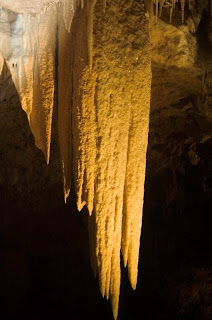
After lunch, we went to the Caves. I’ve never seen stalagmites and stalactites before. I know I will forget this again but while it is still in my memory, I can tell you that the stalagmites are the columns that come up from the ground and the stalactites are the thinner icicle looking features that hang from the ceiling. In this cave they were made of calcium carbonate mixed with rain water that seeps in from above. Everything was in an active growing state (growing with alacrity at a pace of 1 centimeter every 100 years) so we were asked not to touch anything so as not to leave acid from our fingers behind which would kill the fragile and immense structures.

There were no ropes blocking our reach from the features in the cave--just a set of stairs leading us and million of other visitors all throughout the different caverns. The guides just asked us respectfully not to touch. I can’t imagine the U.S. being so trusting or the visitors in the U.S. being so trustworthy.

Anyway, back to the cave. We all were awed by the bizarre hanging crystals. My favorites were called helactites. They were the only structures that didn’t hang down or build up. Helactites are curly, like pigs' tails or shaped like starfish. They grow from the ceiling or out the side of a stalactite and curl into spirals or stretch out in all directions like stars. A sign said that, for the longest time, scientists had no idea how they grew that way. (That, I understood!) They are considering chaos theory as a cause for these gravity-defying anomalies. Here we are in a cave where thousands of crystals have been growing for millions of years. They either grow up or they grow down, except, of course, when they don’t.


View out the family room window of the house we stayed in in Yallingup.


We spent our last of 3 nights in Yallingup and realized that, had we known more before we planned this trip, we might have spent the whole 2 weeks down there. We’d learned about a whole forest of enormous Karri trees that we wished we had planned the time to drive down to and other coastlines further south we wished we could have visited. It is said a million times over that Australia is a vast country and that it takes long stretches of time to drive from one place to another. This trip is the first time since we’ve been here that we’ve really felt inhibited by the vastness. But we’d made our plans so we followed through. It is a school holiday, don’t you know, and everywhere will be packed with people, we were warned. “Too bad you have to travel during school holidays when it will be so crowded with other tourists,” they all said. But I can tell you that Aussies don’t have a clue about crowds. I’m not sure how they define crowds but all we came across were a few scattered friendly faces having as relaxed a time as us and, frankly, if it weren’t for them, I’d have been a bit nervous we were all alone in the world.

Beneath the Southern Cross, Part One

We came back, last weekend, from a two-week trip to Western Australia. When we were in New Zealand, I remember writing a blog almost every night we were there. This time, I wrote nothing until now. So not only will everything be in retrospect, it is very, very long. Therefore, I am going to split things up and try to give this report out in reasonable doses so I don't lose you all. I'll start at the beginning...

What a trip this was. My parents, Phyllis and Dave, and Mark and the kids and I flew into Perth, the only metropolis in the largest state of Australia. We spent the first two nights in the wonderful home of Dave and Salli and 7-year-old Topaz--who are friends of friends back in Colorado. They were incredibly gracious to allow all six of us to take over their home and then spend the day showing us around Perth. This part of the country looked very different than all we've seen on the east coast. It reminded me of southern California. The arid climate sucked all the east coast humidity out of my skin and flattened my hair. Kelly green scrub and stout bushes spot the coastal dunes. Palm trees shaded the streets along the beaches and decorated people’s front lawns just like southern California.


Perth is an easy city. It has bike paths and long stretches of inviting beaches. The CBD (Central Business District is the name all Australian cities and towns call their downtowns) was small enough to not overwhelm. Perth is a very young city. So young that, like a baby, it seems its personality has yet to unfold. I wonder what it be when it grows up? Cosmopolitan? Alternative? Business-like? Resorty? Hard to tell at this point.


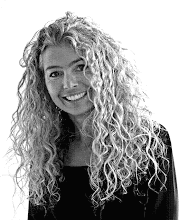
This is Elaine (Dave's mom visiting from Lakewood at the same time we were there) Dave and Sallie. Not the best picture but sadly, we were off our photography game while we were in Perth.


My favorite time in Perth was my 18-mile run along the coast on the bike path that runs in between the cute little beach towns and the ocean. It just felt so easy, so friendly, so sunny and clean. We also visited King’s Park which is an impressive expanse of endless rolling manicured grassy hills dotted with sculptures and playgrounds and fountains and covered picnic areas. A bridge several stories high stretches across the tree tops and, from the middle of it, one can see the cityscape and the Swan River carving its way out to the ocean. It’s a great place to take tourists like us to gape at the beauty of the area.


Here are the kids with Topaz. They had an amazing time together. That's Grandma in the hat above and Salli to the left.


We visited another Australian playground in King’s Park. The US Bar Association would gasp in shock at the potential dangers one can find on playgrounds here. A tiny island inhabited by playground equipment sits in the middle of a river, accessible by a little bridge. The island has no guard rails or ropes or anything around its perimeter to keep small children from falling in the river, not even a sign warning those who are apparently too dim to see the water of the hazards of falling in, and most surprisingly, no signs relieving the park of any liability if a child were to slip off the edge of the island. The climbing structures were high and challenging and accessible for any child to climb on and risk potential death or dismemberment. No care was taken to limit their activity. I loved it! It was so refreshing to see children playing freely on such well-suited climbing apparatuses. I wish American kids had such freedom. Gabe and Jordan have essentially outgrown all the tame and unchallenging American playgrounds, but here you will see kids up through 6th and 7th grade still enjoying the advanced playground activities they find on your average Australian playground. Two points for Australia in my book, (not that I’m keeping score.)


The kids with Topaz at the beach in Perth.


We cleared ourselves and all our stuff out of Dave and Salli’s house and went to pick up our camper van which we hired to live and tool around in for the next 12 days. Our plan was to pick up the camper at 10am and drive a few hours down south to Yallingup where we’d stay in Salli’s brother’s 3-bedroom house for 3 nights. We looked forward to getting there mid-afternoon and having time to get settled, romp around on the 9 acres of country land that the house sat on and get acclimated to the southwest. Unfortunately, the camper van people were not aligned with our desire to get on the road right away. I’m not sure to what business value this camper van company was adhering, but I can tell you it was not efficiency or speed. It took them over four hours to get us loaded up. Due to that unexpected time thief and our 4-hour drive, Monday was shot. But we were fresh, we were up for the adventure and we stopped complaining as quickly as we were each individually able, kids stopped first.

Sunday, April 27, 2008

one term down, three to go

(This blog was written 2 weeks ago ...)

Term 1 of the 2008 school year finished for me on Thursday April 10th, not on the 11th as originally scheduled, as the City of Newcastle decided a couple of weeks ago to give all public employees the day off April 11th to go to the “show”. What is the “show” you ask? Truthfully I cannot tell you much about it as we did not choose to go – Nancy and I opted instead to spend the day together biking and beaching and preparing for our upcoming trip to Western Australia (which is where I sit right now, April 12th, on a plane bound for Perth). Since Gabe and Jordan’s school is an independent school and not public, they still had a normal school day yesterday, so Nancy and I had a “play date”. When I asked my students what the “show” was, they said “You know Sir, the show!” I said like a play or a concert? And they said “No, like a show with rides and stuff.” And then I finally got it – it is Newcastle’s version of a fair – complete with carnival rides, games, concerts and crappy food. Just another thing here that we kind of get but don’t really…..

The past six weeks of school have flown by with a number of holidays, school related excursions, and school wide activities, including another sport carnival and a 2-hour teacher “stop-work” or strike, last week. It seems that the new Labour Government wants to change the teacher staffing agreement and the teachers Federation is up in arms. I may get to experience my first actual full-day strike in May if things do not get resolved soon.

Overall am having much more fun than when the term began back in January/February – partially because I have had so many days off and have enjoyed our travels, (the ones Nancy has done such a great job describing to you) and more significantly as result of “surrendering to what is”. I have come to realize that I am not a one man evangelist who came here to “straighten out” the Australian education system but just a teacher having an educational experience and hoping to help a few kids find their way through Maths at the high school level. I also have a clearer view of how the system works here in New South Wales based on my observations, questions I continually ask of colleagues and conversations with other exchange teachers from around the state.

Here is how it works based on my understanding: All students in Year 7 are tested throughout the year to determine their levels of competency in Maths, English and Science. At the end of that 7th grade year they are then streamed/tracked into classes for the following year based on competency: from 8-1 as the top class to 8-5 or 8-6 on the bottom, depending on the number of students at the school. That class is where they will spend the next three years of high school, with very little chance for movement between classes except in extreme situations and more likely down than up. At that point it is common knowledge that of the say 120 kids in Year 8, only the top 30 have about a 50% chance to go to university, based on statistics from Cardiff and a number of other local schools. The other common knowledge is that all the other 90 kids have to do is show up regularly and take all their exams, not necessarily pass them, just take them, in order to earn their School Certificate after Year 10 ( that is sophomore year for us yanks). At that point, the majority of students do not return to school for Years 11 or 12, but opt to either go right to manual labor type work or secure an apprenticeship.

Please understand that I do not know if this is a good system or not and I make no pretence to judge it on a global good or bad basis. It seems to work for them and it is apparent from our observations that the country is run and wealth is held by the elite 10% and the rest of the people seem pretty equal socio-economically and generally pretty comfortable – they sure travel enough and have plenty of money for food and recreation.

What I do know about this particular education system is that it is difficult to be a teacher in this system as you have most of the classes, really all but the top class, that have no need/desire/motivation to perform at school because there is no upside and very little, if any, consequence for poor performance and poor behavior. So for the most part, the lower classes become a social arena and activity for kids to pass the 190 days per year until they make it to the end of Year 10. Not the easiest teaching situation and my heart goes out to all the educators here that keep working to find ways to engage and motivate the unmotivated. Sometimes it works and I have heard about kids making the leap from 9-3 to 9-2 and then 9-1 over the course of the year. But, that is not the norm. Mostly the lower classes are so unruly and the learning environment is so difficult that it is not possible for a kid to rise to the next level even it they really want to. Surrender to what is.

Now that I understand this all better it is easier to plan my lessons each day and adjust my expectations accordingly. I focus my differentiation efforts on the Year 7s that I can tell have a shot at top class and try to keep the others moving forward at a reasonable pace. I continually seek new ideas and lessons to motivate my 9-3 class, who have come along pretty nicely and are more often working in class these days than kicking the soccer ball or building paper airplanes as they had been doing the first few weeks. I daily celebrate the survival of one more class with my 10-4’s who are the scariest bunch of kids I have ever been left alone in a classroom with but who, in all sincerity, have told me repeatedly that they are doing more Maths for me this year than any year in their past. And finally, I have the pleasure of teaching the 8-1 Maths class this year and they are the joy of my teaching. They are, to a student, polite, receptive, eager, responsible and fun to be around. My one concern is that I must be careful to not take them too far too fast. Last week I introduced them to challenging two-step equation solving in one day, i.e. 3n + 5 = -22 and by the end of that hour there was 90% mastery.

In terms of the faculty, I am thrilled to know these folks. They are kind, helpful, funny and overall good “mates”. They are committed to doing their jobs and are clearly limited and frustrated by the system. They do a great job making the best of the situation and focus on their mates as a way of being engaged in the school.

The administration seems very caring and eager to make improvements, though somewhat powerless against the children’s attitudes and the state's policies.

I do love the hours, 9 to 3:20, and the term breaks, 2 weeks of “holiday” after each 10 week term. I also enjoy wearing shorts to school each day and being close enough to school to use my bike as my main mode of transport. I have become very fond of many of the kids, particularly a group of year 10’s (mostly from the top class of course) that I do sport with each week. A couple of weeks ago two of the boys took me out boogie boarding into the big waves (1.5 meter though they looked 3) – it was a hoot and at school the next day they told some of the other kids that “Sir rocks!”.

Overall I am in a good place these days and look forward to the rest of the year – helping the kids who want it and understanding the rest with a gentler view. And of course enjoying this amazing adventure with my wonderful family and sharing it with all of you.

Blessings on you and yours,

Mark

Wednesday, April 9, 2008

Sydney

Photo by Phyllis Bertke (my mother)

We finally made it to Sydney. Though it is only 2 hours away, we've but skirted this city in the time we've lived in Australia so far. Mark, sadly, had to miss this trip as it was mid-week so I took the kids out of school and we drove down and stayed there on Tuesday and Wednesday in a hotel with my parents. (While we were gone, Mark played golf and ate at McDonalds. He promised his students he'd visit the Maccahs (pronounced MACK-ahs) in Australia and let them know how it compared to Maccahs in the US. He has done his research and in his report he announces that they are exactly the same. Good to know.)


What a beautiful city! We spent time at the aquarium, Darling Harbor, Sydney Harbor, Circular Quay and the Botanic Gardens--all the tourist hot spots for those of you who've been there. I was impressed with the amount of open space and gardens in the middle of one of the biggest cities in the world. Someone was really thinking when they began to develop this area and chose not to cover every hill, slope and valley with buildings. It was truly a lovely city to walk around and I am a good strong critic of places with too many people and their debris.


This is Mr. Incredi-Bubble. He made everyone who passed him by smile.


We have our share of the typical sight-seeing and eating out at good restaurant stories which I will spare you. But there are two stories in particular that I wanted to write about--one more appealing than the other.

The more disturbing story first: We were on our way to dinner on Tuesday evening around 6:30 and we decided to walk the distance to the restaurant which was only about 12-15 blocks, all told. A few blocks into our walk, as we were waiting at a cross walk with throngs of other people, an obviously drunk and likely mentally ill woman approached the kids and me. She was slurring and stumbling and talking loud in our faces, at first just saying hello mostly to the kids. We tried not to react. The kids were nervous, holding my hands and hiding behind me. When the light turned green and we began to cross the street, she got angry and started yelling at us, "That's my daughter. She has my daughter!" It was clear that this woman was going to be more than just an annoyance so the kids and I picked up our pace while my parents and about a dozen other people tried to block her access to us. I was impressed with how safe I felt with all the other pedestrians telling us they would keep her away, suggesting we walk in the middle of the big group they formed around us. The upshot is that it took us about 15 minutes to lose her. We hid in stores while my stepfather watched her and let us know when the coast was clear only to have her reappear on the next corner. Then we'd duck into another store and wait some more. We finally lost her and made it to our restaurant safe and sound and never saw her again, though you can bet we talked about her for the rest of the night. The kids were both terrified. They insisted we take the monorail back to the hotel which, of course, we did.

It was an unfortunate situation though I felt for this woman who was so lost in her world. I shudder to think what the rest of her night was like. But the most interesting parts of that incident were the conversations the kids initiated the rest of the night and next morning. We talked about schizophrenia and medication and alcoholism.

Gabe's questions came out in machine-gun fashion: If medication would help, why won't she take it and who is going to help her get it? Does she have a home and if so, who is going to help her get back there? If alcohol makes people do that why is there alcohol? She can't get us on the monorail because she wouldn't be able to walk up the stairs, right?

Jordan's comments were precious: "It is a good thing we are already sleeping in the same bed tonight, Mama." And, "The scared is so big I don't have any room left for thoughts of food." And on we went. I have to say that navigating their questions was even more difficult than navigating the streets of Sydney with that woman out there. I had to remind myself that part of traveling and having adventures would be eye-opening in ways I wouldn't necessarily be prepared for.

The second story happened while the kids were fast asleep (Grandma took my place in bed early in the morning so no one woke up alone in the hotel room) and I went running. This was possibly the most breathtaking run I've had since I left Colorado, and I run along the ocean at sunrise almost every morning in Newcastle. I ran through the park in the middle of the busy city, and it was plenty busy at 6:00am on a Wednesday morning. And then I headed out toward the harbor. I started off along the left side of the piece of land that juts out and creates the right side of the harbor. First, I ran by a harbor-side pool where I think the Olympic swimmers were practicing. There were heaps of them doing laps quicker than any other swimmers I'd ever seen. They may or may not have been Olympic swimmers but they sure weren't your recreational swimmers out for an early morning workout. Next I ran along the botanic gardens though not through them yet as I was eager to get to the harbor and see the Opera House for the first time.

I came out from under the canopy of huge trees at the end of the land that framed the harbor and onto a lookout spot. Here, I stopped running. In front of me was the harbor and directly across the harbor was the Sydney Opera House. And directly behind the Opera House, stretched the Harbor Bridge. Behind the bridge, the cityscape and behind me, rose the sun. It was one of the most spectacular scenes I have ever seen.

After taking this in for a few moments, I ran along the inside of the harbor now toward the Opera House. All of this running was on bike paths, by the way and it was all done in the company of about 1.2 million other runners. It didn't feel crowded though, just populated. As I neared the Opera House, I was aware of my growing excitement and I began to see that I was going to be able to run right up to it. There is something deeply moving that I imagine happens inside many of us, maybe most of us, when we see in person something so famous, so widely talked about and so unique. That was happening in me. That alive feeling, that feeling of being a part of history and future, of being a part of this huge world that contains The White House, the Taj Mahal and the Sydney Opera House. I used to get this feeling when I was in Washington DC staying with my father and I'd ride my bike right around the National Monument or walk right up to the Lincoln Memorial and touch the words on the wall.

So I ran around the Opera House and learned that the white tops are made of tile.


I'd always wondered what they were made of. Not metal, not canvas, not some mysterious material unique to the Opera House but ceramic on top of cement, in case you were curious yourself.

From there, I ran almost under the Harbor Bridge, along Circular Quay, which is where all the ferries, trains and buses access Sydney Harbor from surrounding areas. On my way back to the hotel, I ran through the Botanic Gardens which are vast and gorgeous and, incidentally, laid out all upside down, making it hard for a runner to find her way home once she's in there.

It was such a fabulous section of the world that I took my kids and parents down the same path I ran down so I got to see it all again at a slower pace later that morning. I highly recommend Sydney to anyone who's remotely interested. Two days was enough for me, however. The time came to get this country girl out of the belly of the busy city.

From there, we brought my parents back up the road to Newcastle where they stayed with us for a week. And here are some pictures I've stolen from my mother the photographer:


This is one of the resident koalas at the Blackbutt Reserve by our house.


Next, we have a few of the 15,000 bats who live at Blackbutt and who are supposed to be sleeping during the day like the crew on the left. But every time we walk through here, we find plenty who are wide awake like these guys on the right.


This is a lorikeet--a very shy bird. And this is a picture only my mother could take.


Gabe just recently turned eight and so we invited eight kids to his party in a park. Here they are eating cake:


And here is what they looked like the other two hours and twenty five minute of the 2 1/2 hour party:

This is the first, though probably not the last, year that Mark was fully in charge of the activities at the party.

And now, just three days before we leave for our two-week holiday in Perth and the west coast, I am caught up with the blog. Phew! I don't know if I'll write from Western Australia or wait until I get home so if you don't hear from me, just know we will be back in touch soon! We love you all and hope you are all well and happy...
Tuesday, April 8, 2008

Jervis Bay with the Exchange Teachers

Throughout this year, an Australian cohort of past exchange teachers will put together activities for current exchange teachers to attend if we choose. It's really a wonderful offering and they do it voluntarily. It would be like us coming home next year and hosting all the current Australians who are living in Colorado for a weekend, say, in Crested Butte.

Two weekends ago, we got to spend the weekend with exchange teachers from Colorado, Washington State, The UK, Scotland, Ireland and Canada in an area about 5 hours south of here called Jervis Bay. Few quick orientation facts--it was much cooler than Newcastle and the water was fr-fr-fr-freezing. We didn't go in. We saw far fewer people and inhabited areas than we're accustomed to seeing in Newcastle and north of here. I hadn't realized how much I missed the New Zealand flavor of the rich, green untouched land. On our drive down, we saw leaves changing on trees which we hadn't seen in Newcastle (though this week it is beginning here too). We saw rolling, green pastures and farm land with old trees the size of hot air balloons lining the drainage paths in the crooks between the hills.

We stayed at a university satellite location on a reserve that is completely owned and managed by aboriginals--so they can keep their land in the condition they see fit and allow visitors on their terms. The campus we were on had a huge kitchen, communal bathrooms and tiny little cabins that looked a bit like jail cells before we laid out our sleeping bags and freed our clothes from our duffle bags.


This is Jordan feeding a wild King Parrot (though we don't think this was the parrot's first time being fed)


Just a cute little tidbit that I don't want to forget: the kids slept in their own little room next door to ours (walls thin enough to hear each other softly snoring) with bunk beds. Jordan chose the top bunk. The first night there, they each crawled in bed, pretty excited about having their own room. We said good-night and went back to the big kitchen where the adult party was going on. About 10 minutes later, I went back to check on them and they were laying right next to each other on the bottom bunk, half asleep and all cuddled up together. Apparently, we learned the next morning in detail, Jordan couldn't sleep. Gabe said, "Try falling asleep for 10 more minutes and if you can't then you can come down and sleep with me." Something like 10 minutes passed and she let him know she was still awake so he told her to come down and so she did. They both reported sleeping soundly all night long.

Anyway, chatting with the other teachers and spouses of teachers was probably the most interesting part of this weekend. Many teachers, if not most teachers, are struggling with the same issues Mark is. Many teachers are having a significantly worse time than Mark is. Some people are pretty unhappy with the part of Australia they are living in. Many people seem to have been handed the challenge of accepting what is and finding the good in it. It was sort of disheartening to hear all the frustrations and struggles. I was surprised there were so many. There were also some people who were having a blast and saw their teaching situation as just a downside to this whole year. There was only one person who is standing out in my mind right now who truly enjoys their teaching experience. Otherwise, the complaints were mainly about the frustrating lack of resources and the incredible discipline problems. Most people were enjoying their co-workers. But on the whole, this was a pretty upbeat group of people and there were a number of them we really enjoyed. We all welcomed each other into our homes and made sketchy plans to come stay in their different towns. I left there feeling indescribably lucky that our final match of the four that came our way was in Newcastle as it is clear to me now that we could have been placed in a pretty undesirable part of the country. Thank you Prue for choosing to come to Colorado!!


We went on a dolphin watching cruise (and as I may have said in an earlier blog, it is my opinion that these sorts of cruises should all be about 45 minutes long rather than 2.5 hours but what are you gonna do?)


And here is one of the many ways we found to entertain ourselves during the remaining two hours we weren't actually watching dolphins...this is Jordan being a bottlenosed dolphin.


The highlight of the weekend was a several hour long, intimate presentation by two aboriginal people who came to share with us their culture and history. They were very personable, hilarious and extremely informative. We learned about a piece of grass that, if you pull it out by the root, which looks like the white part of a celery stick, and blow on it, it will emit a high pitched sound. The vibration of that sound will be picked up by snakes both friendly and deadly, and they will come to see from where the vibration is coming. This is how aboriginals brought snakes out of the bush. They'd be ready with a rock that they'd throw at them to kill them for dinner. They told us about a time they were presenting to a group of children at a school and some time later, a child was blowing on this grass in the playground and a red-headed black snake (very deadly) came slithering out of its hiding place to visit the children. They made us promise we wouldn't try that on our own.

I was affected by hearing so many stories about aboriginal life, specifically about how pure their culture was before white people intruded and how much has been lost for them in recent times. I am heartened by those who are finding their way back to their roots. These people seemed to have a gift to merge cultures without denigrating either.


We did go in the water on our last morning not because it was warm but because it was irresistible. You could swim out quite far and be way over your head and still see the bottom.


We returned home on Sunday afternoon, the kids went to one day of school on Monday and then we were off to Sydney to meet my parents on Tuesday morning. Next blog...Sydney