Tuesday, May 6, 2008

Beneath the Southern Cross, Part Six and Out

I haven’t mentioned yet that it was only because of the dolphins that we were even out on the beach that morning. It was really cold with strong chilly winds blowing that sent us inside as soon as the dolphins swam back out. The kids and my parents found an empty movie room where the Planet Earth series about the ocean was playing so they cozied up in there and watched about two hours of documentaries. Mark and I found some wind-protected sun and laid in it like lizards.

I guess we must have fallen asleep because the next thing we knew, my parents were telling us that they’d left the movie room and Gabe had made some friends and they were all playing Frisbee around the corner. I pictured a bunch of eight-year old Australian boys on holiday with their parents. But when we walked around the corner to come see, opening up in front of me was: Grateful Dead meets seaside resort. Gabe’s new friends were 20-something guys who’d come to Monkey Mia prepared to play. They had Frisbees and juggling balls and those sticks you can make dance. We ended up spending the day with them. There was Gil and Omri and Ruven
from Israel and another
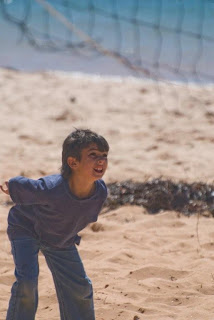
guy from Spain and two women from France. Suddenly, after all the flies and long desolate outback driving, stinging sand and frigid morning winds, low-budget accommodations with a sink that wouldn’t drain and a grocery store with sketchy-looking meat and produce, finally after all that, we’d found a bit of paradise.There were dolphins, palm tree-spotted grassy areas, happy music, a friendly cafĂ©, a sun that was warming everything up, and new friends to play with. My parents took pictures and read in the shade. Mark and Gabe and I played volleyball with
some Israeli, German and Dutch folks. Jordan made the dancing sticks dance and made us all some delectable chocolate chip cookies out of sand. Gabe learned to juggle. Mark and the kids took out a canoe while I took a little nap in the sun. We laughed and played all day. I think the last thought on each of our minds as we drifted off to sleep that night was, “Thank God.”


We enjoyed who Gabe referred to as “The Guys” quite a bit and now have a place to stay when we visit Israel. One of the funniest things I’ve ever heard is an Israeli saying, “Good on ya mate!” Spending time with a group of people from all over the world in Monkey Mia, Western Australia kicked wide open the doors to international travel in my mind. For my entire 38 years, the world has always seemed a faraway place to me. It’s been a world of which I feared I may never see more than pictures. And the US has always seemed vast enough to be a world unto itself. It seems things have been flipped onto their heads for me as the world now feels like it is right around the corner and the US but a very small part of it all.
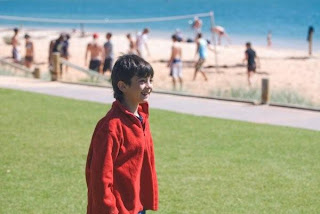
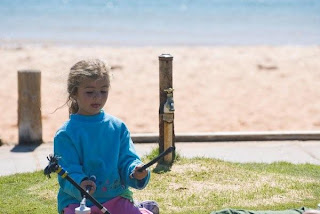
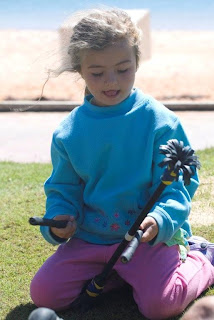
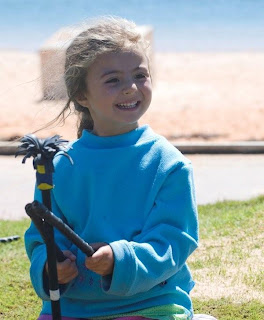


We all agreed that Monkey Mia was worth seeing afterall. Therefore, we awoke early the next morning to greet the dolphins and interact with them on what to them was just another Wednesday morning. Gabe had a bit of a hard time watching the dolphins on the second day as his head kept jerking backwards to the grassy area to see if The Guys were there yet. I’ve never heard him so excited to see anything appear in his life than he was when The Guys rolled out of bed at about 10am and sauntered out into view. “They’re here!!!” he yelled and took off running toward them faster than a bat outta hell.
We learned a new Aussie phrase that morning. We had spoken, the day before, with Capes, the Aboriginal tour guide who told us that he’d be happy if we joined him on his morning guided walkabout the next day. All we had to do was meet him right here at 8;30am. So we dutifully showed up at 8:30 am and he wasn’t there. We checked with the information people who said that that tour was fully booked. Fully booked? We’d just spoken with him the day before and he didn’t say anything about needing to make a booking. So we thought the information people must have been mistaken and we went back out to wait for Capes. He never did show up. We found it all very peculiar that he didn’t show up for a fully booked tour that no one else seemed to be waiting for either. We mentioned it to one of the dolphin rangers a bit later and he laughed. ‘Fully booked’, he explained, means that Capes won’t be in today. Maybe he had a late night the night before, wink, wink. But for all intents and purposes, that tour is ‘fully booked.’ Got it.

On our second day in Monkey Mia, after the dolphin had had their morning tea and chat with the people, we ran into another exchange family who were also visiting this part of the country during their school holiday. The 10 of us took ourselves on the guided bush walk and enjoyed laughing and chatting with this other family who are from Seattle and having challenges and joys during their adventure in Australia as well. The afternoon was another lovely day on the beach, in the water, playing with The Guys and relaxing like one does at a resort.
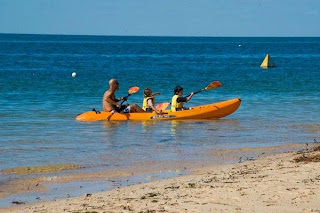
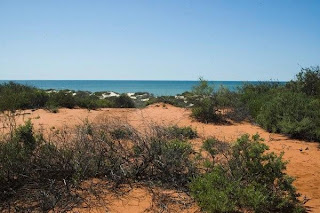
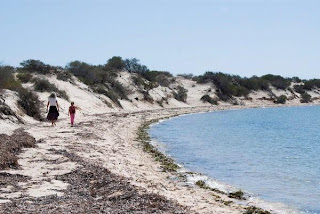
Once we befriended Shark Bay or it befriended us, I realized that the land we were in was quite spectacular. I loved seeing the red dirt of the off-shore land butt right up against the white sand on the beaches. At one point I was looking out the front window of the camper and I could see deep red dirt on my right and bright white sand on my left as though I were in two different places at once. The ocean was just as phenomenal as it ever is. My stepdad, who is an ex-naval officer and submariner commented that he'd never been on the Indian Ocean before. I asked him if it looked any different, wondering if it maybe had an Indian flair to it. He said he couldn't see much of a difference but that he might if he got to know it better. I loved the rich red and kelly green colors next to each other especially with the bright blue sky as a canopy over both. I knew that against all odds, I was going to miss this place.

We had one more night in Denham (the town just down the road from Monkey Mia that we were staying in) so we made our way back there and while Mark and the kids went to the grocery store, bless their hearts, I had a rare opportunity to walk through a museum without children. My parents and I visited a surprisingly gorgeous museum telling the story of Shark Bay. I learned so much about the history there that what had felt like a god-forsaken, fly-infested, wind-blown forbidding section of the world was becoming a place I was falling in love with. I learned about the Aboriginal history there and the indescribable tragedy of their early experiences with Europeans. I learned more about the animal life, the struggles they have with non-native animals and their efforts to return the area back to its natural state. Through some video documentaries that played in a loop for anyone to drop in and have a listen, I heard from people who’ve lived in Shark Bay all their lives and what their impact has been on the land over the years. This whole experience taught me so much about sitting still and seeing what’s really there rather than coming into a place with expectations that it be something I already know. It wasn’t a coastal paradise like so much of the eastern coast has been for us. It was harsh. It was empty. It was dry and intimidating. The people were rugged. Of the six of us, I may have been the one that wanted to leave the most. I was trying to talk Dave and Mark into driving the camper van back down south through the middle of the night. But we didn’t leave and I didn’t spend the three days there waiting for the time to pass so we could go back somewhere better. I sat still and watched and learned and found an incredible amount of joy in exactly what was there. We didn’t create a good time for ourselves, we just allowed one. When it was time to go, none of us wanted to. None of us.

Luckily, on our way out of town the next morning, we had one more stop to make that allowed us to prolong our fun. We stopped at a place called Ocean Park. Ocean park is either open from 9-5 or 10-5 depending on which of the signs you believe as you drive down their road. Apparently the 10-5 sign was the accurate one because their gate was still closed at 9:00. But we really wanted to come see this place as it was touted to have a shark display that was well worth seeing and really good coffee. So I went in and asked the guy who was in the middle of his breakfast if he wouldn’t mind us coming in a bit early because we were on our way out of town. He was more than happy to accommodate us and within 15 minutes, we’d begun a private tour with him through Ocean Park.

This is a place with about a dozen man-made tanks of all sizes and they temporarily house the sea creatures that live in the surrounding ocean. What they do is go out almost daily and go fishing. When they catch things, they bring them home and put them in their tanks. When the creatures start showing signs of not wanting to be in captivity anymore (usually by stopping eating) they release them back into the wild. As a result, we were able to see sea snakes and sting rays and huge groper fish the size of small pigs and tiny little clown fish and turtles and a lobster and a squid and several huge sharks. They sometimes have in their tanks hammerheads and blue sharks and great whites. This day they had lemon sharks, sand sharks and a nervous shark (that’s just its name but I couldn’t help feeling sorry for it.) We watched him hold a big, bloody fish head out on a long line for the sharks to swim by and attack. I could feel my adrenaline spike just a bit every time one of those animals jumped out of the water with its mouth wide open and teeth poised to pierce some skin and I wasn’t even in the water. After a while, a crowd joined us on our tour and someone asked if you had to worry about these sharks if you were to see them in the water. Our guide replied, “You don’t have to worry about any sharks. What’s to worry about? If you see one, just get out of the water.” He seemed serious. It was a little disturbing.

Ocean Park was the last stop of our visit to Shark Bay. We drove back down the road off the peninsula and bid adieu to the swarms of flies we knew we were leaving behind. We settled back into our places in the camper and readied ourselves for the long drive back down through the empty and vast desert.

About halfway to Geraldton, where we were to spend the next two nights, we stopped at a National Park called The Pinnacles. Remember that for hundreds of kilometers behind and ahead of us all we saw was red dirt, squat dried green scrub and one two-lane road splitting down the middle. That was it. Nothing else. Until we turned left down this road and suddenly we were on another planet. We were surrounded by light tan/white rocks that stuck up like giant stalagmites (remember that word?) Thousands of pillars of rock stood anywhere from one foot to ten feet tall. A wax museum of petrified ghosts. And I’m sorry but it would take a stronger woman than me to talk about the pinnacles without referring to their phallic nature. Quite a bizarre place in the middle of nowhere.

We got out of our camper and climbed all over the pinnacles, trying to keep our thoughts out of the gutters. The kids got to eat their lunch on the top of one. We played hide-and-seek behind them. We saw two wild emus saunter by like they were native New Yorkers making their way down a crowded 5th Avenue. It was quite a spectacle. At the risk of sounding not very smart, I will tell you that there was a sign that explained the theory of how the pinnacles came to be and why only in that particular area. Alas, those scientists lost me after the first few sentences. I can tell you there were rains and mountains and a build up of sediment and that it all happened a very, very long time ago. But that’s about as far as I can take you.

We had our fill of the strange tall rocks, remarked about the absence of flies and climbed back into the camper to make our way back to Geraldton. We spent two nights here and had a nice time renting bikes, walking around town, going to the beach and swimming though the water was pretty cold. It was a relaxing time in Geraldton but not a lot of excitement to add to the blog.
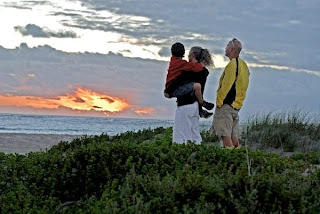
Our trip was just winding down at this point. We left Geraldton, made our way back to Freemantle to spend our last night and then returned the camper and got on the plane. We said good-bye to Western Australia. Who knows if any of us will ever return.

All in all, we were all pretty impressed with our flexibility—at least in our behavior if not always in our attitude. Had we known what we were getting ourselves into ahead of time, we probably wouldn’t have booked the trip in this way. But we were all deeply glad we did.

We came back to Newcastle and one of the most remarkable things to me was how genuinely happy we were to be “home.” It really does feel right here. We are happy to be here. We found out from someone the day after we returned that while we were gone, it had rained non-stop for 13 days in Newcastle—the entire school holiday. Monkey Mia just scored another point.

My parents stayed with us for 2 more days after our trip and we were all very sad to separate when they left. It’s so good for us to be together and so hard to say good-bye. The kids really benefit from having people come visit I think. And so do Mark and I. They made it home safe and sound, reporting that after being gone from the US and immersed in a slower culture for 6 weeks, they are missing it here. I can only imagine.

So back into our lives we’ve gotten. Everyone’s back in school. I’m back to my writing and other projects and activities that I’m enjoying. And there will be more blogs to come as things unfold. Our love to all of you!

Beneath the Southern Cross, Part Five

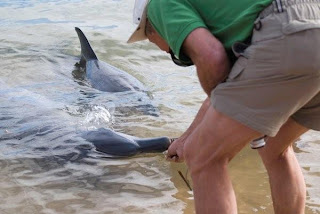
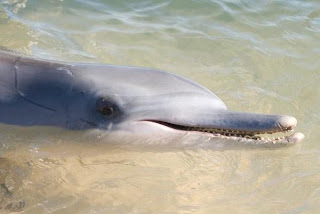
The next morning, we woke up early with the specific intent of going to visit the dolphins. Monkey Mia is one of very few places in the world where wild dolphins come up to the shore to be fed. It’s a fascinating story, really. About 50 years ago, a woman began feeding a dolphin off her boat. She did that long enough and consistently enough that she taught the dolphin how to come eat fish from her hand right off the beach. Within a few years, tourists came and swam with that dolphin and the others who had heard the news and had come to join in. After a short while, as you might imagine, the people started mistreating the dolphins, feeding them all sorts of crap, distracting them from getting their own food in the ocean, handling them too much, etc. The dolphins were too friendly with humans and they were endangering their own lives. A group of biologists/conservationists took over the care of these dolphins about 10 years ago by coming up with a protocol of feeding. This is how it works: Every morning, 365 days a year, the dolphins are offered 3 feedings between 8am and noon. It is up to them whether and when they come for those feedings. When they first show up near the beach in the morning, a wildlife expert or 2 or 3 will stand knee-deep in the water as 2-5 dolphin swim at their ankles. The rangers talk to the crowd of tourists who are about ankle deep in the water and tell them all about the dolphins. They’ll talk and answer questions for about 20-30 minutes while the dolphins just hang out and schmooze with the crowd, swimming up and down the length of the crowd along the edge of the ocean. After the rangers have talked all about them and their history, they bring down buckets of food with the names of each of the 5 dolphins on them.

They only feed 5 and those five are females who are 10 years or older. The five they feed are Nikki, Puck and her daughter Piccolo, Surprise and her daughter Shock. They’ve been feeding Nikki and Puck and Surprise since they were 10 years old and before that, they fed their moms. The rangers pick one person from the crowd at a time to come take the fish and hold it under the water for the dolphin to come take. Jordan was picked twice to do this as we witnessed 4 feedings over 2 days. After the fish are gone, the dolphins usually swim away and come back, or not, for another 2 feedings later in the morning. The rangers only feed them a small snack to allow the dolphins continue to get the bulk of their food on their own. Sometimes the dolphins come back later in the day just to see people but they don’t get fed.


They don’t seem to come just for the food. The dolphins really seem to enjoy the human interaction as much as the humans. It is amazing to watch. The dolphins will swim slowly by the crowd on their side so their eye is up out of the water so they can see everyone. They have distinct personalities that the rangers refer to as they talk about each of the dozens of dolphins that hang out in Monkey Mia who all have names and birthdates. They say that the mama dolphins tend to bring their new babies to the shore to show them off to the rangers the day they give birth. They don’t feed babies who are still nursing (which some can do for up to 6-8 years, my goodness) because they want to make sure they are fully capable of taking care of themselves in the wild. They don’t feed males because, apparently, male dolphins are not good guys. They are aggressive and sort of one-track minded. They are focused on teaming up with a few other males, corralling a female when she is in season and kidnapping her. They take her out to sea for a few weeks and won’t let her get away. Then they all mate with her and then let her go. Usually, 12 months after a female dolphin disappears from the beach at Monkey Mia for a few weeks, she’ll have a baby. One of the rangers said if you were thinking about coming back in your next life as a dolphin, don’t come back as a female. They have a rough life. Kidnap, rape, up to 8 years of nursing if their baby isn’t killed by a shark which 50% of them are, and they never go through menopause so they can be impregnated even when they are old and over it.


That sort of dented my dolphin-worshipping bubble. But the way these rangers care for these
amazingly smart and gorgeous mammals is very inspiring. They are a model program and other parts of the world are working to emulate something similar. The goal is to allow masses of people to have up-close interactions with dolphins so that the animals get into the hearts of people who will do what they can to protect them from maltreatment without disturbing the natural habits of the animals.

Thursday, May 1, 2008

Beneath the Southern Cross, Part Four

Shark Bay is the name of a large area. The bay itself is enormous and the land mass surrounding the bay is a peninsula that juts out from mainland Australia and is the most westerly point on the continent. (I like that I can now say that I’ve been to the most easterly point in Australia, the most westerly point and the southern-most land mass in the world besides Antarctica. I don’t know that I’ll make any money off those claims but everyone’s gotta have something.)


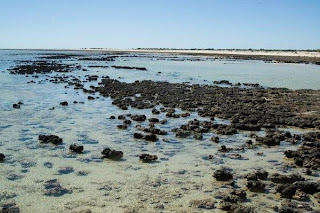
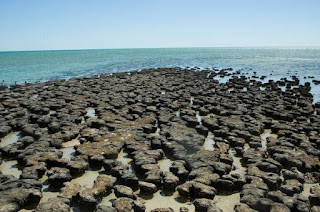
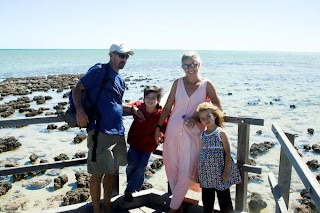
As we began our venture onto this peninsula, we stopped at a few recommended places. The first was the home of the Stromatolites. Now these guys deserve their own blog page, their own website. Tiny, microscopic organisms called cyanobacteria build up to form these stumpy rock-looking creatures called Stromatolites that live in the ocean.


These stumpy rock things are my new heroes. 350 billion years ago, give or take, there was not much oxygen on the earth so it was not a very friendly place for life. The only living things were these cyanobacteria who apparently didn’t need much. But what these organisms did was produce oxygen. Over a few billion years, they increased the amount of oxygen in our atmosphere just enough to make it possible for other, more complex life forms to survive here. Without them, you’d not be reading this blog right now. So while we may feel a deep connection to the chimpanzee as a distant relative, it is these stumpy Stromatolites to whom I feel I owe my life. They only exist in this one area in the entire world because the sea right there is so high in saline that it is too salty for any other animal to live in and therefore, safe for these fragile little Stromatolites because there are no predators or competition for food. Seeing them and learning about their role in, well, in my life, made me feel like I had completed the ultimate pilgrimage. If it weren’t for the flies, I’d have stayed with them to pay homage much longer. But the flies drove us back to the relative sterility of the camper van and on we drove to our next stop.


Shell Beach is a beach where tiny, white, perfect seashells are piled by the trillions, 30 feet deep for several miles. There is no sand to speak of. Just shells. Most of them so tiny you could fit two or three of them on a dime. It is spectacular. But the climate there was just unreasonable. At the parking lot end of the beach were the flies. Once you got on the beach, the fly population thinned (notice I didn’t say disappeared) but the winds picked up and whipped specks of tiny shells at our legs. The sun bounced off the white shells producing a brightness that scoffed at our sunglasses. We decided it was a good time to let the kids run free and because we were in a bay, the water was calm enough for them to practice snorkeling.


Sadly, it was freezing and none of us could stay in for very long. I thought I’d go for a swim to work off some of my building frustrations with our new climate but the ocean was so shallow that for what looked like miles, it didn’t even reach my knees. Things were starting to look more and more grim and we were having a harder and harder time shaking it off. We toweled off the kids and bundled them and their purple lips back into the camper and drove the rest of the way to our caravan park.

The Denham caravan park. Let’s just say it was low-budget. The good news was that when we arrived in this little town just down the road from Monkey Mia, we discovered that the flies had disappeared. Because the 80 mph winds made it impossible for them to land anywhere. The sand, on the other hand, had no trouble at all stinging our legs and arms and faces as we tried to walk down the street in town. We finally had to just turn around and escape the gale force winds by staying in our cabin the rest of the afternoon. But we had something to do—we put our heads together to form an escape plan. We were all miserable (except, of course, my stepdad who, for those of you who don’t know is pretty much happy anywhere,) and we all wanted out. We thought about driving in the middle of the night to get back to civilization, we called all sorts of other caravan parks around Perth to find somewhere else to stay. We talked about some of us flying down to Perth from there while two people drove the camper van back. We were willing to forfeit deposits and spend more money on alternative accommodations. We were willing to sell our souls to get out of there. We felt like we’d just driven over 10 hours straight into the belly of hell. But because it was the school holiday, the supposed masses of travelers, with whom we still hadn’t crossed paths (though it was now becoming clear where they all were,) had reserved everything in Perth. We were stuck. We couldn’t leave because we had no where else to go. It became clear that our only option was to muster up all the internal resources with which we were each endowed and make do.

Beneath the Southern Cross, Part Three

Because bookings had been made, we drove north. We stayed a night in Freemantle which is a town right on the edge of Perth. We were told that Freemantle is a colorful, alternative town. I was eager to see it. We read somewhere that historically, it was a port town and that a hundred years ago, it was a really rough place to hang out--men brawling in the streets, women of the evening lurking on every corner, etc. It also is the home of a very large and well-known prison though I don’t know if there is any direct relationship between it being a rough town and it having a big prison. Anyway, while it has changed its appearance from a major port to a touristy coastal town, it still felt rough around the edges. We had more issues with street people, there were lots of ruffian-looking kids hanging around, scantily-clothed women and gawky men. I hadn’t seen characters quite like this anywhere else in Australia so far, except maybe Sydney. I love how the tone or feel of a town can stay with it for hundreds of years.

We had our first caravan park experience in Freemantle. We reserved a little cabin at a few of the caravan parks along our way so that the six of us wouldn’t have to shower, potty, cook, eat, sleep, drive and store everything all in the same 6’ X 20’ space for 2 weeks. After our first night with a cabin in Freemantle, Mark got on the phone and reserved a cabin for every night for the rest of the trip. If it weren’t for those cabins, I can pretty much guarantee that all six of us would not have survived this trip. Who thinks six people should live in a tiny camper van for 2 weeks? It seems to me that camper van companies should take some moral responsibility for the mental health and well-being of their customers before they send six people out in a tiny capsule on wheels for an extended period of time. The cabins we rented saved our souls.

I think we are up to Friday. Friday was a big driving day. We went north, out of Freemantle, past Perth and into new territory. The plan was to drive half-way to our final destination which was Shark Bay and stay the night in Geraldton. It took us about 6 hours to get to Geraldton and it was a long and lonely road. The climate was even drier and we had to take a major detour to get near the coast as the main highway was quite a bit inland.


We stopped at a beach to let out some pent up energy and it was windy, sand-duney and spotted with scrub bushes. The towns were miniscule along this coast leaving us wondering who might venture up this far and why would anyone want to live here. I think we were all holding out hope that even though the road between Perth and Shark Bay was desolate, once we got there, it would be beautiful.

We stayed the night in Geraldton after making a huge mistake of buying a disgusting excuse for Thai food from what looked like a decent restaurant and nobody eating any of it. Except for Dave who enjoyed his meal just fine. We got up early the next morning and hit the road again.

This drive was even more remote. There was absolutely nothing between Geraldton and Shark Bay, 5 hours later, except red dirt, scrub, a two-lane highway and some road kill. At least we thought that was all that was out there. Come to find out, there were also flies. Clouds of them. We stopped at a rest area and were assaulted when we got out of the camper. They were shameless. You could bat the same fly away a dozen times and it would not give up. Back and back and back they came to land on our faces, crawl up our noses, perch on our lips and explore our inner ears. They crawled up our legs and arms and dozens of them at a time would hitch long rides on our backs. I’ve never experienced flies in this quantity in my life. It was intolerable. We were scurrying back to our car from the toilets and passed a couple who wore mosquito-netting over their heads to cover their faces. We knew right then, we were in trouble.

These are a few of our flies on my mother's back.


Kids passing hours in the back of the camper. They were amazing travelers.

It can’t be that bad in Monkey Mia, I kept saying. We’ll see, said everyone else. I couldn’t believe we could have made reservations to spend 3 days in an uninhabitable part of the world.


Beneath the Southern Cross, Part Two

The next day, Tuesday, rained non-stop but, again, we were fresh, we were up for the adventure. Our as of yet untapped stamina allowed us to enjoy ourselves on the cold rainy day. We drove our 6-berth camper van through the rolling hills of the wine country, ducked into a chocolate factory and a nuts and cereal shop. Margaret River is the largest town in this area so we window-shopped Margaret River, going in to more shops than we probably would have had we not been seeking breaks from the downpour. My mother was content inside the metal framed camper listening to the rain all afternoon.

The next day turned out to be one of the best on our trip. It didn’t rain which was a great start. We spent the morning at Canal Rocks and the afternoon at Ngigli Caves. Canal Rocks is a section of the coast where rocks jut straight out of the
sand at the edge of the ocean.


This phenomenon exists for some geological reason that scientists tried to explain to me via signs along the path. I didn't understand their explanation while I was reading it and so it probably isn't right for me to just make stuff up. Suffice it to say, we had a blast climbing on them.The waves crashed up against them and then retreated leaving behind a clear sheen of water that revealed heaps of crabs of all sizes and colors scrambling around on the rocks. We found a blow hole where the water had eroded the rock so if you waited patiently, every-once-in-a-while, one of the biggest waves would throw itself down this canal in between two rock walls to the end where there was a hollowed out rock with a hole on the top. The water would disappear under the rock and spray up the hole misting all who dared stand close enough to see. Good fun!

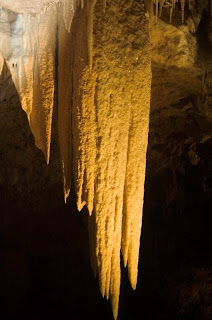
After lunch, we went to the Caves. I’ve never seen stalagmites and stalactites before. I know I will forget this again but while it is still in my memory, I can tell you that the stalagmites are the columns that come up from the ground and the stalactites are the thinner icicle looking features that hang from the ceiling. In this cave they were made of calcium carbonate mixed with rain water that seeps in from above. Everything was in an active growing state (growing with alacrity at a pace of 1 centimeter every 100 years) so we were asked not to touch anything so as not to leave acid from our fingers behind which would kill the fragile and immense structures.

There were no ropes blocking our reach from the features in the cave--just a set of stairs leading us and million of other visitors all throughout the different caverns. The guides just asked us respectfully not to touch. I can’t imagine the U.S. being so trusting or the visitors in the U.S. being so trustworthy.

Anyway, back to the cave. We all were awed by the bizarre hanging crystals. My favorites were called helactites. They were the only structures that didn’t hang down or build up. Helactites are curly, like pigs' tails or shaped like starfish. They grow from the ceiling or out the side of a stalactite and curl into spirals or stretch out in all directions like stars. A sign said that, for the longest time, scientists had no idea how they grew that way. (That, I understood!) They are considering chaos theory as a cause for these gravity-defying anomalies. Here we are in a cave where thousands of crystals have been growing for millions of years. They either grow up or they grow down, except, of course, when they don’t.


View out the family room window of the house we stayed in in Yallingup.


We spent our last of 3 nights in Yallingup and realized that, had we known more before we planned this trip, we might have spent the whole 2 weeks down there. We’d learned about a whole forest of enormous Karri trees that we wished we had planned the time to drive down to and other coastlines further south we wished we could have visited. It is said a million times over that Australia is a vast country and that it takes long stretches of time to drive from one place to another. This trip is the first time since we’ve been here that we’ve really felt inhibited by the vastness. But we’d made our plans so we followed through. It is a school holiday, don’t you know, and everywhere will be packed with people, we were warned. “Too bad you have to travel during school holidays when it will be so crowded with other tourists,” they all said. But I can tell you that Aussies don’t have a clue about crowds. I’m not sure how they define crowds but all we came across were a few scattered friendly faces having as relaxed a time as us and, frankly, if it weren’t for them, I’d have been a bit nervous we were all alone in the world.

Beneath the Southern Cross, Part One

We came back, last weekend, from a two-week trip to Western Australia. When we were in New Zealand, I remember writing a blog almost every night we were there. This time, I wrote nothing until now. So not only will everything be in retrospect, it is very, very long. Therefore, I am going to split things up and try to give this report out in reasonable doses so I don't lose you all. I'll start at the beginning...

What a trip this was. My parents, Phyllis and Dave, and Mark and the kids and I flew into Perth, the only metropolis in the largest state of Australia. We spent the first two nights in the wonderful home of Dave and Salli and 7-year-old Topaz--who are friends of friends back in Colorado. They were incredibly gracious to allow all six of us to take over their home and then spend the day showing us around Perth. This part of the country looked very different than all we've seen on the east coast. It reminded me of southern California. The arid climate sucked all the east coast humidity out of my skin and flattened my hair. Kelly green scrub and stout bushes spot the coastal dunes. Palm trees shaded the streets along the beaches and decorated people’s front lawns just like southern California.


Perth is an easy city. It has bike paths and long stretches of inviting beaches. The CBD (Central Business District is the name all Australian cities and towns call their downtowns) was small enough to not overwhelm. Perth is a very young city. So young that, like a baby, it seems its personality has yet to unfold. I wonder what it be when it grows up? Cosmopolitan? Alternative? Business-like? Resorty? Hard to tell at this point.


This is Elaine (Dave's mom visiting from Lakewood at the same time we were there) Dave and Sallie. Not the best picture but sadly, we were off our photography game while we were in Perth.


My favorite time in Perth was my 18-mile run along the coast on the bike path that runs in between the cute little beach towns and the ocean. It just felt so easy, so friendly, so sunny and clean. We also visited King’s Park which is an impressive expanse of endless rolling manicured grassy hills dotted with sculptures and playgrounds and fountains and covered picnic areas. A bridge several stories high stretches across the tree tops and, from the middle of it, one can see the cityscape and the Swan River carving its way out to the ocean. It’s a great place to take tourists like us to gape at the beauty of the area.


Here are the kids with Topaz. They had an amazing time together. That's Grandma in the hat above and Salli to the left.


We visited another Australian playground in King’s Park. The US Bar Association would gasp in shock at the potential dangers one can find on playgrounds here. A tiny island inhabited by playground equipment sits in the middle of a river, accessible by a little bridge. The island has no guard rails or ropes or anything around its perimeter to keep small children from falling in the river, not even a sign warning those who are apparently too dim to see the water of the hazards of falling in, and most surprisingly, no signs relieving the park of any liability if a child were to slip off the edge of the island. The climbing structures were high and challenging and accessible for any child to climb on and risk potential death or dismemberment. No care was taken to limit their activity. I loved it! It was so refreshing to see children playing freely on such well-suited climbing apparatuses. I wish American kids had such freedom. Gabe and Jordan have essentially outgrown all the tame and unchallenging American playgrounds, but here you will see kids up through 6th and 7th grade still enjoying the advanced playground activities they find on your average Australian playground. Two points for Australia in my book, (not that I’m keeping score.)


The kids with Topaz at the beach in Perth.


We cleared ourselves and all our stuff out of Dave and Salli’s house and went to pick up our camper van which we hired to live and tool around in for the next 12 days. Our plan was to pick up the camper at 10am and drive a few hours down south to Yallingup where we’d stay in Salli’s brother’s 3-bedroom house for 3 nights. We looked forward to getting there mid-afternoon and having time to get settled, romp around on the 9 acres of country land that the house sat on and get acclimated to the southwest. Unfortunately, the camper van people were not aligned with our desire to get on the road right away. I’m not sure to what business value this camper van company was adhering, but I can tell you it was not efficiency or speed. It took them over four hours to get us loaded up. Due to that unexpected time thief and our 4-hour drive, Monday was shot. But we were fresh, we were up for the adventure and we stopped complaining as quickly as we were each individually able, kids stopped first.